Fire, Steel, and Patience: The Chiba Swordsmiths Who Refuse to Let a Living Art Form Die
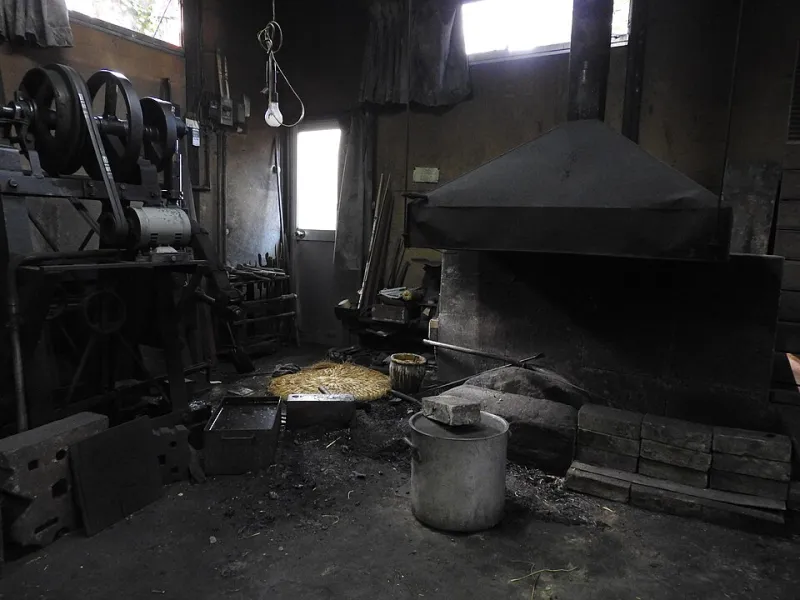
Photo: MathieuMD, CC BY-SA 4.0, via Wikimedia Commons
The forge is going before sunrise. By the time most people are checking their phones, Kenji Watanabe — third-generation swordsmith, Chiba Prefecture — has already been at work for two hours. The charcoal burns at temperatures that make the air above it ripple. The steel glows colors that have no real names in English. And Watanabe watches all of it with the focused calm of someone who has done this thousands of times and still doesn't take a single heat for granted.
"The steel tells you things," he says, not looking up. "You have to learn how to listen."
This is what's left of one of the world's most demanding craft traditions — and in Chiba, at least, it's more alive than you might expect.
Why Chiba?
The connection between Chiba Prefecture and sword-making runs deeper than most people realize. The region's historical ties to samurai culture are well documented — the Chiba clan, one of the most powerful warrior families of medieval Japan, called this area home for centuries. Where samurai culture flourished, the demand for quality blades followed. Smiths settled here. Knowledge accumulated. Workshops established lineages.
When the Meiji government banned the wearing of swords in 1876, the industry collapsed almost overnight. Most smiths pivoted to other metalwork or disappeared entirely. The few who kept the traditional craft alive did so largely as cultural preservation, working within the strict licensing system that Japan put in place to control sword production.
Today, Japanese law limits the number of licensed swordsmiths operating in the country and caps each smith's annual output — a regulation designed to protect both the craft's integrity and its scarcity. In Chiba, a small community of these licensed smiths has managed to sustain itself, connected by mutual respect, shared resources, and a collective stubbornness that borders on the philosophical.
The Making of a Blade
For anyone unfamiliar with traditional Japanese swordsmithing, the process is almost comically labor-intensive by modern standards. It begins with tamahagane — a raw steel produced by smelting iron sand in a clay furnace called a tatara. The resulting bloom is broken apart, sorted by carbon content, and then folded and welded repeatedly to distribute the carbon evenly and eliminate impurities. A single blade can involve dozens of folding cycles before the smith is satisfied with the material.
The shaping, grinding, and polishing that follow are equally demanding. A traditionally made katana can take months from start to finish, and that's before the blade reaches the specialist craftspeople who handle the handle, the guard, and the scabbard — separate disciplines, each with their own deep traditions.
Watanabe walks through this process with the matter-of-fact tone of someone describing a commute, but the pride underneath it is unmistakable. "Every part of this blade has my attention in it," he says. "There's nowhere to hide. If I'm careless for one hour, the blade shows it."
Passing the Fire
The existential threat to traditional swordsmithing isn't lack of interest — it's the pipeline. Training under a licensed master is the only legal path to becoming a certified swordsmith in Japan, and the apprenticeship is long, demanding, and financially difficult. Young people who might have the talent and the passion often can't afford the years it takes.
Several Chiba smiths have made deliberate efforts to address this, taking on apprentices with the explicit goal of ensuring continuity. One workshop has begun hosting structured educational visits for students from local universities, partly to recruit and partly just to keep the knowledge visible. Another has partnered with a martial arts organization to document traditional techniques in video format — not as a replacement for in-person training, but as an archive.
"I'm not training someone to make swords for me," says one smith who has mentored three apprentices over the past decade. "I'm training someone to outlast me."
A Global Collector Base
The market for traditionally made Japanese swords is genuinely international. Serious collectors in the United States, Europe, and across Asia seek out blades from certified smiths, and the reputation of the maker matters enormously. A blade from a respected Chiba smith can command prices well into the tens of thousands of dollars — and the waiting lists at top workshops stretch years.
Martial artists, particularly those practicing iaido and kenjutsu, represent another segment of the demand. For practitioners who train seriously with live blades, the performance characteristics of a traditionally forged katana — its flex, its edge geometry, its balance — are not merely aesthetic considerations. They're functional ones.
This international interest has, somewhat ironically, helped sustain the craft domestically. The revenue from high-value sales funds the workshops that keep the tradition alive, and the global attention draws a kind of prestige that makes the work visible to younger Japanese people who might otherwise never encounter it.
More Than a Weapon
Spend enough time around Chiba's swordsmithing community and you start to understand that the blade is almost beside the point. What these craftspeople are really making — what they're really preserving — is a way of paying attention. A discipline of presence that has no shortcut and no substitute.
In a world where most things are optimized for speed, there's something quietly radical about a process that genuinely cannot be rushed. The steel doesn't care about your schedule. The fire doesn't negotiate. And the smiths who work here, in their small workshops with their early mornings and their careful hands, seem to find something in that resistance that the rest of the world has mostly forgotten how to value.