Hammers, Halfpipes, and Heritage: How Chiba's Ancient Blacksmith Tradition Sparked a Modern DIY Revolution
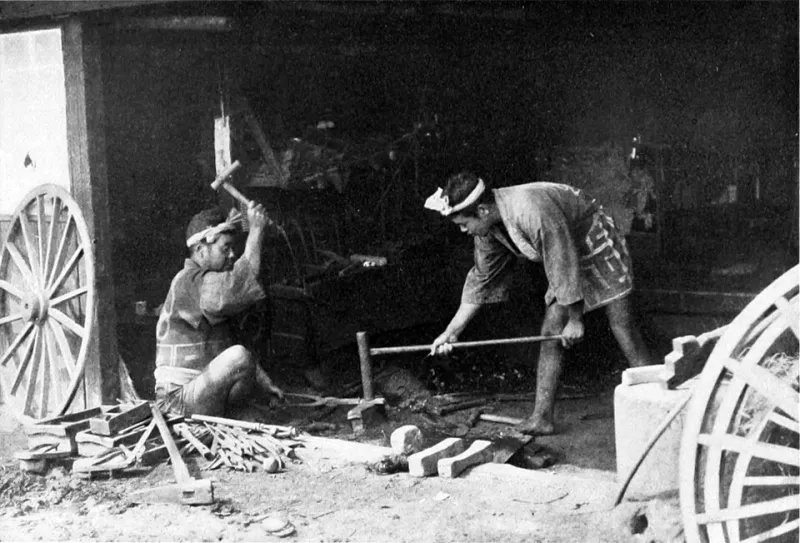
Photo: Captain F. Brinkley, Public domain, via Wikimedia Commons
There's a particular sound that drifts out of a narrow workshop in Chiba City on Saturday mornings. It's not what you'd expect from a neighborhood that looks, on the surface, like any other mid-sized Japanese suburb. It's the sound of a hammer meeting hot steel — rhythmic, deliberate, almost musical. And sitting behind that hammer is a 28-year-old in a Dead Kennedys t-shirt.
His name is Ryota Hamasaki, and he'll be the first to tell you he didn't grow up dreaming about blacksmithing. He grew up skating. But somewhere between grinding rails in Makuhari and stumbling into an old metalworking shop his grandfather used to run, something clicked. "I realized the same instinct that makes you want to customize your board," he says, wiping soot from his forearm, "is the same instinct that made people here forge their own tools for a thousand years. It's all just making something real with your hands."
That connection — between Chiba's deep metalworking past and its scrappy, creative present — is something a growing number of people in the prefecture are starting to take seriously.
A Prefecture Built on Steel
Most Americans associate Japan's craft metal traditions with Kyoto or the mountain provinces. Chiba doesn't usually make the list. But the prefecture has a quietly significant history of ironwork that stretches back to the feudal era, when local smiths were producing agricultural blades, fishing implements, and — yes — swords for the samurai class that dominated the Kanto region.
The town of Chiba and its surrounding areas sat at a strategic crossroads between the sea and the inland plains, making it a natural hub for craftspeople who needed to supply both farmers and warriors. Generations of families built livelihoods around the forge. Techniques were passed down through apprenticeships that lasted decades. The work was grueling, precise, and deeply embedded in local identity.
That identity didn't disappear when industrialization arrived. It just went underground.
The Punk Smiths of Chiba
Walk through the backstreets of Chiba's older commercial districts today and you'll find pockets of metalworking activity that feel completely out of step with the gleaming shopping complexes nearby. Small workshops, many of them operating in the same buildings they've occupied for generations, sit wedged between convenience stores and vending machines.
What's changed is who's working inside them — and what they're making.
Mei Tsuruta runs a studio she calls Tetsu Lab (tetsu means iron in Japanese) out of a converted storage unit in Ichikawa. She makes furniture, sculptural wall pieces, and custom hardware for streetwear brands. Her aesthetic is unmistakably industrial — raw welds, exposed bolt patterns, surfaces left intentionally rough. But her technique? That comes straight from the traditional forging methods she learned from an elderly craftsman in her neighborhood who'd been working the same way since the 1960s.
"People see my work and think it's just edgy design," she says, laughing. "But everything I do has a reason rooted in how metal actually behaves. The old guys taught me that. You can't fake it."
Tsuruta is part of a loose creative network that's been quietly building momentum in Chiba over the past decade. It doesn't have an official name or a manifesto. It's more like a shared sensibility — a belief that making things by hand, with real materials, in real space, is both a political act and a cultural one.
Skate Culture as the Bridge
If traditional metalworking is the foundation, skate culture is the ramp that launched this movement into wider visibility. Chiba has a surprisingly robust skating scene, fueled in part by its geography — wide industrial zones, low-traffic coastal roads, and the kind of concrete infrastructure that skaters treat like a playground.
The crossover between skaters and craftspeople happened organically. Riders who wanted custom trucks or personalized hardware started showing up at local workshops. Smiths who'd never thought about youth culture suddenly had teenagers asking them to help fabricate parts for modified boards and custom bike frames. The exchange went both ways.
Ryota Hamasaki is a direct product of that collision. His current project — a line of hand-forged steel accessories that fuse traditional Japanese motifs with graffiti-influenced line work — has already attracted interest from boutiques in New York and Berlin. He's careful not to oversell it. "I'm not trying to be some ambassador for Japanese tradition," he says. "I just like making stuff that looks cool and lasts forever. If people connect with that, great."
The International Ripple
It would be easy to dismiss all of this as a local quirk, the kind of niche creative subculture that exists in every city and rarely travels. But Chiba's metalworking revival is starting to generate real attention beyond Japan's borders.
Several Chiba-based makers have been featured in American craft publications and design blogs over the past few years. A pop-up showcase organized informally in 2022 drew buyers from as far as Portland and Amsterdam. Part of the appeal, observers say, is the authenticity — there's no manufactured backstory here, no marketing team deciding what the "brand narrative" should be.
What you get instead is a genuine continuum. Old craft, new hands, a city that never quite let go of its industrial identity even as the world around it changed.
What's Next for the Movement
The challenge, as always, is sustainability. Traditional metalworking skills are genuinely difficult to learn and take years to develop. The elders who carry the deepest knowledge are aging out. And Chiba, like many Japanese cities, faces demographic pressures that make it hard to attract and retain young creatives who might otherwise head to Tokyo.
But there are reasons for optimism. A handful of informal apprenticeship programs have started connecting older craftspeople with younger makers. Local community centers have begun hosting metalworking workshops that routinely sell out. And the underground network that Tsuruta, Hamasaki, and others have built — loose and unstructured as it is — keeps drawing in new people who stumble across it and decide to stay.
"Chiba doesn't need to be Tokyo," Tsuruta says, straightening a piece of steel on her workbench. "It just needs to keep being itself. That's always been enough."
She's probably right. There's something in the air here — salt air, if you want to get poetic about it — that seems to encourage a particular kind of stubbornness. The kind that keeps people hammering long after it would have been easier to stop.