Rust, Weeds, and Wonder: Chiba's Forgotten Amusement Parks and the Ghost of Japan's Bubble Economy
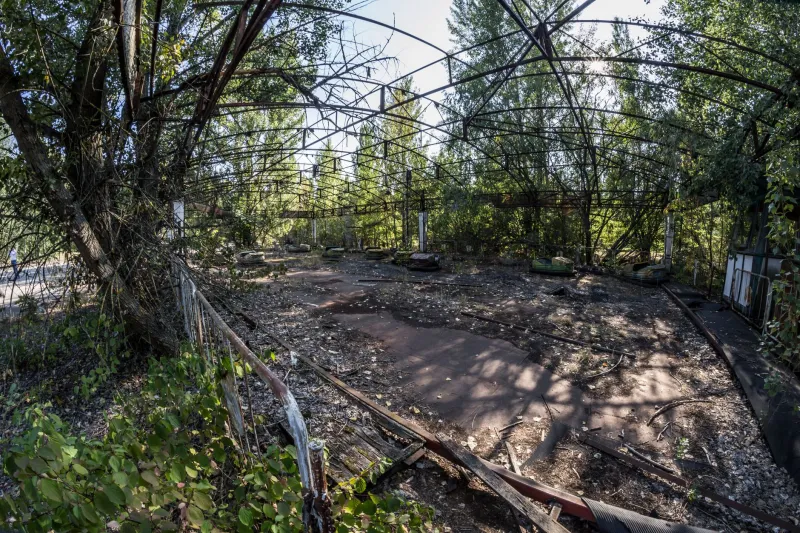
There's a Ferris wheel outside of Chiba City that hasn't turned since Bill Clinton was in his first term. Its gondolas still hang at odd angles, painted in faded pastels that were probably cheerful once — cotton-candy pink, sky blue, a yellow that's gone the color of old newspaper. Vines have started climbing the support structure. Birds nest in the operator's booth. On a quiet weekday morning, with fog rolling in off Tokyo Bay, the whole thing looks less like a broken ride and more like a monument to something nobody quite agreed to memorialize.
Welcome to Chiba's forgotten fairgrounds — a loose constellation of defunct amusement parks scattered across the prefecture that urban explorers, historians, and curious locals have been quietly documenting for years. They're not on any tourist map. Most of them don't have official names anymore. But if you know where to look, they're everywhere: a collapsed roller coaster here, a rotting carousel pavilion there, the concrete skeleton of a haunted house attraction slowly being reclaimed by bamboo.
For Western visitors, these places might register as simple curiosities — the Japanese equivalent of a shuttered Six Flags. But they're actually something more specific and more interesting than that. They're physical evidence of one of the most dramatic economic implosions of the 20th century, and they carry a particular kind of cultural weight that's hard to fully understand without a little context.
When Japan Decided to Have Fun — Hard
To understand why Chiba ended up with so many of these places, you have to rewind to the 1980s. Japan's so-called Bubble Economy was in full effect, and money was flowing in ways that seem almost hallucinatory in retrospect. Real estate prices in Tokyo were so inflated that the land under the Imperial Palace was theoretically worth more than the entire state of California. Consumer spending was through the roof. Leisure culture exploded.
Chiba, sitting right on Tokyo's doorstep with cheap land and good rail connections, became a natural dumping ground for entertainment investment. Developers who couldn't afford Tokyo prices could still build something big and splashy in Chiba and count on the capital's millions of residents to make the short trip out. Amusement parks, resort complexes, and theme attractions popped up across the prefecture throughout the late '80s and into the early '90s — some of them genuinely ambitious, others essentially elaborate cash grabs dressed up in fiberglass and neon.
Then the bubble burst. Asset prices collapsed. Consumer confidence evaporated. Suddenly, those weekend trips to a mid-tier theme park in Chiba didn't feel quite so appealing — not when families were tightening belts and Tokyo Disneyland (which, confusingly, is also in Chiba) was right there offering a more polished experience for not much more money.
The smaller parks didn't stand a chance.
What the Workers Remember
Koji, who asked us not to use his last name, spent three summers in the mid-1990s working at a now-demolished water park near Ichihara. He was a teenager then, earning pocket money running the lazy river attraction. "It was packed in the beginning," he told us over coffee in Chiba City. "Families, school groups, couples on dates. The parking lot was always full on weekends."
By his third summer, the crowds had thinned noticeably. "Management kept saying it was temporary, that things would pick back up. They started cutting staff hours. Then one autumn they just... didn't reopen the following spring." He shrugs. "I found out from a friend. There was no announcement."
That quiet, unceremonious closure — no farewell season, no liquidation sale, no formal goodbye — turns out to be a recurring theme. Many of Chiba's defunct parks didn't so much shut down as simply stop opening. Maintenance crews stopped showing up. Ticket booths went dark. The rides stayed exactly where they were, and nature started making its own plans for them.
Miyuki, a former ride operator at a separate park near the Boso Peninsula coast, describes something similar. "There was a sense that it might still come back," she says. "For years, I think the owners were hoping to sell the land or find investors. So nothing got demolished. It just sat there." That legal and financial limbo — properties too expensive to maintain, too complicated to sell, too costly to demolish — is a big part of why so many of these sites remain standing today.
The Urbex Community and Chiba's Accidental Museums
If you spend any time in urban exploration communities online, you've almost certainly seen photographs from Chiba's abandoned parks without knowing it. The imagery is genuinely striking: a bumper car arena where every vehicle is still parked in place, coated in dust; a log flume ride with the flume half-collapsed into itself; a carousel with horses that have weathered to an unsettling, eyeless blankness.
Japanese urbex photographers have documented these sites extensively, and their work has developed a following well beyond Japan's borders. There's something about the combination of childlike imagery — rides designed to delight — and the evidence of long decay that hits differently than, say, an abandoned factory. The intended emotional register was joy. The current emotional register is something more complicated.
For Western audiences specifically, there's an additional layer of fascination. These parks were often designed with a very particular vision of fun that was itself borrowed and filtered through a Japanese lens — American-style roller coasters, European fairy-tale castle aesthetics, retrofuturist space themes. Walking through the ruins, you're essentially looking at a twice-removed cultural artifact: Japan's interpretation of Western leisure culture, now itself historical.
What Gets Lost and What Stays
Not everything has been left to rot. A handful of former park sites have been redeveloped — cleared, built over, turned into housing or commercial space. Others have been partially preserved by local historical societies or folded into municipal green space in ways that feel more accidental than intentional.
But the majority exist in a kind of legal and physical purgatory, still technically owned by entities that may or may not still exist in any meaningful corporate sense, fenced off but not demolished, visited mainly by people who probably shouldn't be there.
There are occasional conversations in Chiba about what to do with these spaces. Some advocates argue for formal preservation — treating the most intact sites as genuine historical landmarks, the way the US has started rethinking industrial ruins as heritage sites. Others think the land is simply too valuable to leave idle indefinitely.
For now, though, the Ferris wheel keeps rusting. The carousel horses keep fading. And somewhere in Chiba, on a foggy morning, a ride operator's booth sits empty with a window cracked open just slightly, as if someone stepped out for a break and never quite made it back.
There's a whole era of Japanese pop culture frozen inside those fences — loud and colorful and full of a specific kind of optimism that the country hasn't quite recovered, and maybe hasn't needed to. It's worth knowing it's there.